
Clinton Previous Residents by Era
No single record names every earlier household at a Clinton address. The dependable trail shifts with the era. A modern parcel card pins down a situs and legal description. Deeds follow title. Maps preserve the street and lot context for each Clinton generation. Archives and local collections fill the earliest gaps. The table keeps confirmed Clinton coverage separate from unknown online start dates. So a search never overstates what the sources hold.
| Source | Years It Covers | Where Held | What It Shows |
|---|---|---|---|
| Hinds Landroll parcel cards | Current Clinton layer; historical start not stated | Hinds County online Landroll | Assessed owner, situs, legal description, deed placement, map and GIS links |
| Hinds General Index | Online Clinton start not stated | Hinds County / Chancery Clerk | Grantor, grantee, instrument, book-page, date, and some remarks |
| MDAH Hinds land and tax material | Clinton-area land transactions from 1822; selected tax rolls 1822–1861 | MDAH finding aids and reading rooms | Landholders, deed parties, lots, and legal descriptions |
| Clinton map series and plan | 1856/1883/1913; 1970–2004 | MDAH Clinton map collections | Street grid, lots, and address context, not occupancy |
| Printed directory and telephone leads | Exact Clinton run not confirmed | Clinton Quisenberry genealogy room | Possible household or address evidence after staff verification |
The Landroll fits a current Clinton address. Move to MDAH land and tax material once the parcel's online path ends. Older households need other leads. A library inquiry, newspaper notice, marriage catalog entry, and census lead should each be logged as separate evidence, never folded into one unverified story.
Lock a Clinton Address First
Hinds County's Landroll is the practical first stop for a Clinton address. Its Clinton street search takes a street name with the direction entered separately. Leave out suffixes and abbreviations. The county lists Street, Drive, Road, Lane, St, Dr, Rd, and Ln. A street number pulls that number and up. Partial mode helps with uncertain spellings.
Save everything the parcel card offers. The Clinton parcel number, map reference, situs, legal description, and subdivision belong in the notes. The assessed owner, mailing address, and deed book, page, and date belong there too. The card can also link to a Clinton map and GIS view. An assessed owner and a mailing address are tax fields. The situs is the parcel's physical location. None alone proves who lived there.
Keep the Clinton address as printed. Add a normalized copy to the notes. Direction, unit, lot identifier, map reference, and legal description go in separate fields. An old Clinton deed may omit a familiar street string. A modern address can change while the lot description stays useful.
Clinton Previous Residents Deed Chain
The Hinds County General Index is the route into Clinton title history. Enter the name as last name first, no comma. The form offers Grantor, Grantee, or Both, plus Deed of Trust, Deed Book, or Both, with optional start and end dates. Broad Clinton searches can run slowly. Public results cap at 500. The county states no online beginning year and no image-access pricing.
- Locate the Clinton situs in Landroll and copy its Clinton parcel number, legal description, map reference, and current deed book or page.
- Open the Clinton parcel map and GIS links to check the lot and nearby parcel context before relying on a street-number match.
- Search the current Clinton assessed owner in the General Index as grantor and grantee, using a date window around the parcel-card deed date.
- Capture the Clinton instrument, date, party roles, book-page, and legal-description text from each relevant result or remark.
- Use the prior grantor as the next known Clinton person, then repeat the search while testing initials, spelling variants, trust names, and entity names.
- Contact the Chancery Clerk or MDAH when an online Clinton result is missing, a full instrument is needed, or the older trail must move to books, microfilm, or finding aids.
A sample Hinds General Index remark shows the kind of book-page and legal-description text a search result may expose. Treat it as a format example. It proves no one lived at the Clinton address being studied.
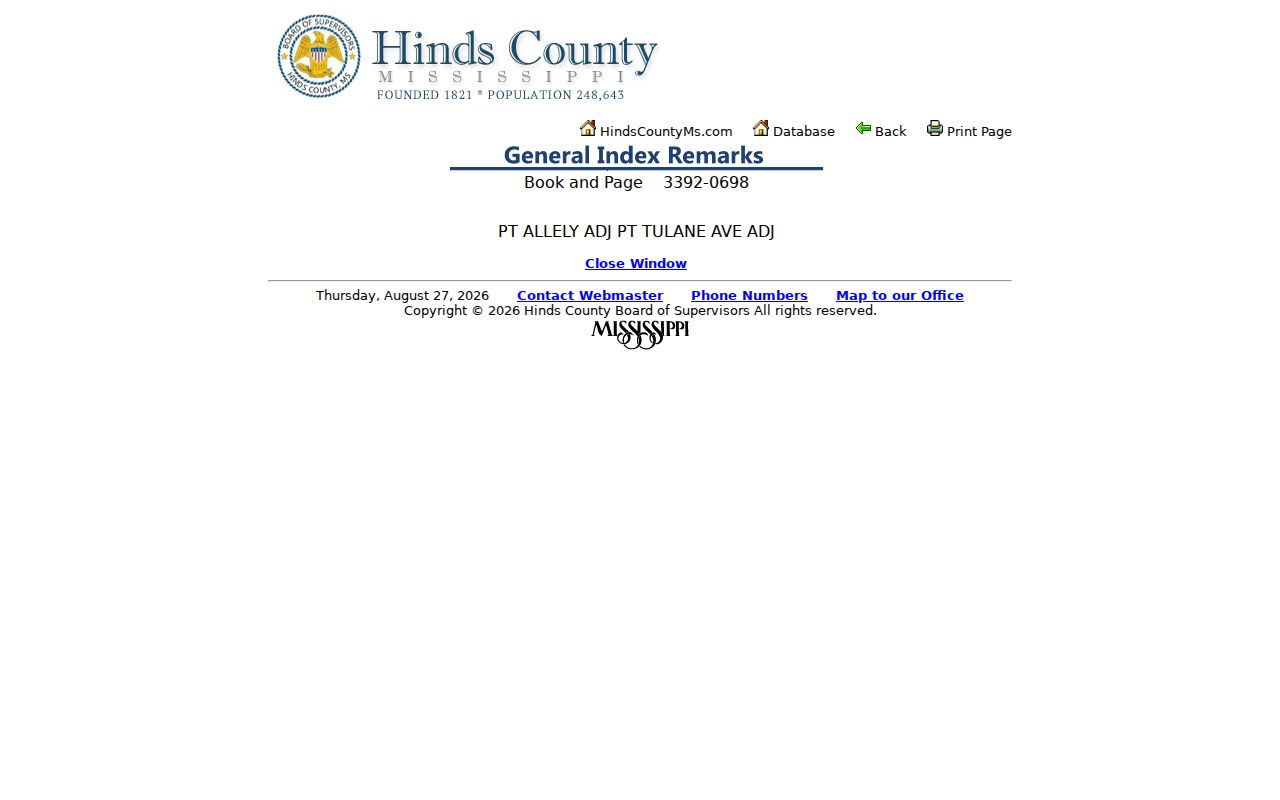
The online index supplies a starting trail. When a book-page, deed image, or earlier instrument matters for the Clinton chain, confirm the full record with the Chancery Clerk.
- Grantor / grantee
- The grantor transfers an interest in a deed; the grantee receives that interest. Roles must be read from the individual instrument.
- Chain of title
- A dated sequence of transfers tied to the same parcel or legal description, worked from a known record toward earlier ones.
- Legal description
- The lot, subdivision, metes, bounds, or other land wording used to identify the parcel. It can remain stable when an address changes.
Clinton Previous Residents and Lots
A street address alone is a weak historical key. It still helps. A deed may cover a larger tract, a former lot, or an adjacent alley in Clinton. The General Index returns a party name, instrument type, book-page, and date. Sometimes a remark carries legal-description text. Match that wording against the Clinton Landroll subdivision, lot, and map reference before linking an older deed to a later Clinton address.
Never merge a mailing location with a situs. A Hinds parcel card can list an out-of-town post-office box for the assessed owner beside a separate physical location. The two fields answer different questions. A dated deed establishes a transfer. Occupancy needs its own proof. Nothing in a deed shows the grantor, grantee, or mail recipient living at the site.
Note: A stable lot description is often the best bridge across a revised street name, parcel split, or changed house number.
MDAH’s Clinton Land Trail
MDAH's Hinds County finding aids stretch the local land trail back to transactions beginning in 1822. Confirmed tax material is rich. Combined rolls cover 1822–25, 1827–30, 1831, and 1833–41, with later rolls for 1846, 1848, and 1861. They name landholders, not whole households. These records shine when a modern parcel trail points toward an older Clinton lot, family, or legal description.
MDAH also points to police-court minutes from 1848–1858, naturalization declarations from 1870–1908, and delinquent tax lists from 1874. A sheriff or tax ledger covers 1916–1917. Poll-tax receipts and voter-registration cards run from 1956–1965. Each series serves a different purpose and access path. Record the name, date, series, and page or item reference, and treat it as a narrow corroborating fact rather than an occupancy conclusion.
Hinds records are old. Record-keeping in the county predates Clinton's digital systems by roughly two centuries. That gap is the point. A Clinton address history eventually leaves web forms behind for clerk records, archive finding aids, microfilm, and reading-room research.
Clinton Previous Residents on Maps
The Olde Towne district still keeps its 1829 grid and lot layout. MDAH publishes Clinton maps for 1970, 1971, 1974, 1982, 1995, and 2004. A still older bridge exists. The 1856 plan was transcribed in 1883. It was copied again in 1913. That gives researchers three vantage points on the same ground. Before deciding that an old address and a new one name the same spot, compare each against its lot and street setting. Renamed, extended, annexed, and renumbered streets are common in Clinton. The map series is the way to catch them. Let each sheet speak for itself. Note honestly wherever a label or boundary stays uncertain. The map gives location context only. It proves no household, no title transfer, and no mailing tie.
Clinton Previous Residents and Sanborn
The Library of Congress Sanborn guide describes what each digitized map entry shows, including city, state, date, sheet count, notes, and downloadable files. The Library of Congress search returns no Clinton-specific sheet. That matters. Hold off on writing a map year into a Clinton address history until an actual sheet turns up and you have looked at it yourself.
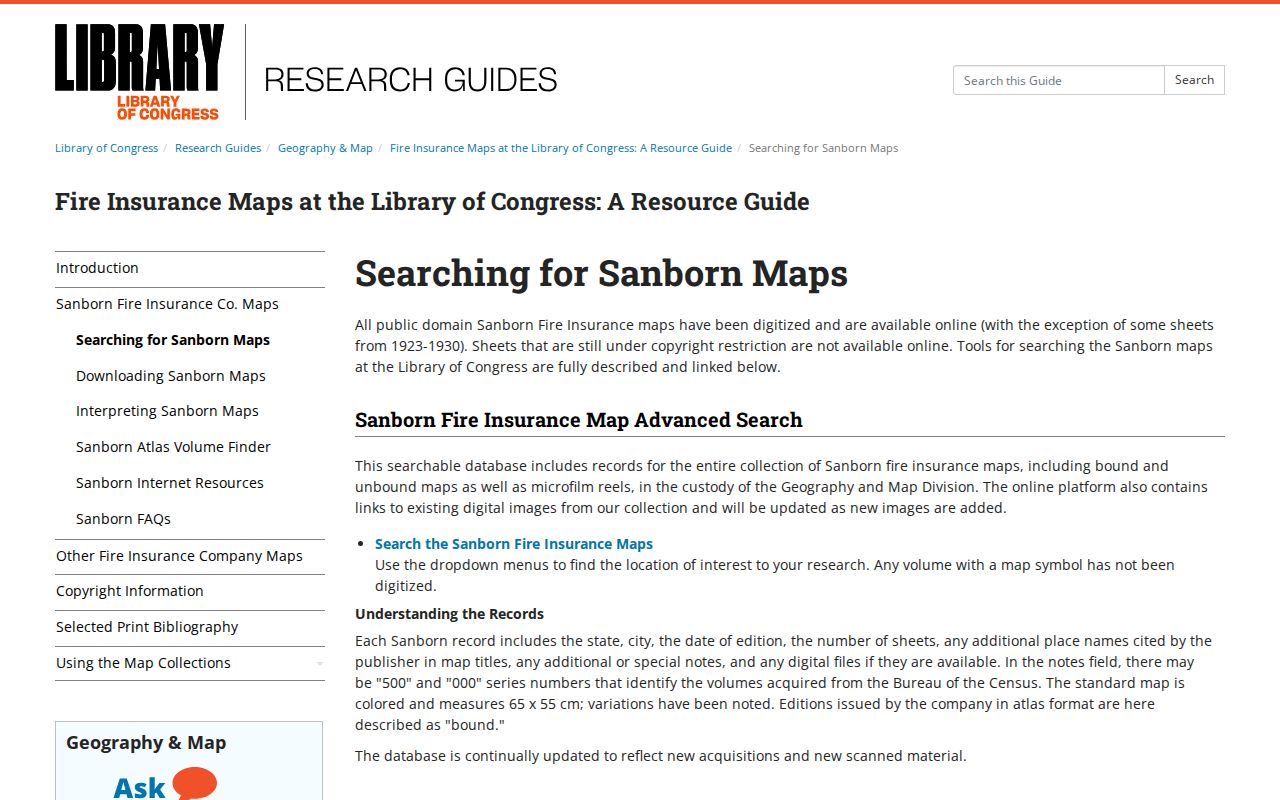
Work the confirmed MDAH Clinton map series while you keep searching. Try the historic city name, Hinds County, and neighboring Jackson catalog terms. Ask Quisenberry Library and MDAH staff directly whether Clinton sheets sit in an on-site drawer. They may also rest in a neighboring collection. Until one surfaces, treat Sanborn coverage as an open gap in Clinton research.
Clinton Past Households in Directories
Ownership is only part of the story. A printed directory can carry a household clue for past residents of Clinton. So can a telephone book or a reverse directory. The same goes for a census schedule or a newspaper notice. An obituary, marriage record, or cemetery source may help too. No Clinton-specific city-directory run or local census transcription is confirmed to exist. Quisenberry's genealogy room is the practical place to ask about exact holdings. The historical collections appear on the Clinton city directory page.
Pair Clinton sources by date, not by assumption. A directory entry may name a Clinton occupant in one year. A deed may name an owner in another. A newspaper or marriage catalog can tie a Clinton name to a date. Note what each source calls the person. Note whether the address is printed. Also note whether you are seeing an original image, an index, or a staff referral.
- Set the parcel, legal description, and map context beside the approximate household year.
- Ask Quisenberry for a printed or reverse directory, telephone book, yearbook, clipping file, or newspaper lead for that period.
- Pair a found entry with the closest available census or archival name source, keeping each date separate.
- Use obituaries, cemetery referrals, probate material, and newspapers as end-point leads rather than automatic proof of an address.
Clinton Previous Residents Name Anchors
Chronicling America lists two 1838–1839 Clinton titles with nine issues each. It also carries Sword and shield for 1885–1888 with 78 issues. Even sparse papers can surface a Clinton merchant. They can also carry a marriage, land sale, court notice, or public announcement. Search a surname alongside Clinton or Mount Salus. Try Old Vicksburg Road or a known lot and street clue too. Save the issue date and page.
FamilySearch catalogs Hinds marriages for 1854–1937 on one 35mm reel. The index runs by groom, bride, and year. Viewing images may take a FamilySearch account, a FamilySearch Center visit, or library access. A marriage entry can anchor a name to a record placement. But it cannot prove either party lived at a particular Clinton address. You need separate address evidence for that.
Clinton Previous Residents, Used Respectfully
Old addresses in Clinton open doors to the past. A dated address trail can settle an estate question. It can also support family research or explain how a parcel changed hands over the decades. Neighborhood history projects draw on the same records. Treat every Clinton lookup as a study of context. It is not a tool for tracking a living person. Never use past-resident information to contact, follow, or harass anyone. Even a current entry in the residents directory can be incomplete. Older records often carry spelling slips or relationships that are easy to misread.
Lawful use. Mississippi’s Address Confidentiality Program can provide a substitute mailing address for qualifying victims, so an absent residential detail may be a protection, not a research failure.
Uncertainty deserves respect. When a Clinton record is unclear, say so rather than guessing, because the distinction between owner, occupant, grantor, grantee, and mailing recipient is what keeps any past-resident search both accurate and fair.